


You can change your brain, but that change happens in stages …
Your brain is not a finished product, and that might be some of the best news you will hear all day. For a long time, the common belief was that once we hit adulthood, our brains were essentially set in stone and our habits, personality quirks, and skills were locked in for life. We now know that simply isn’t true. Through a biological process called neuroplasticity, your brain possesses the same characteristics as a muscle — it physically reshapes, strengthens, and rewires its architecture based on how you use it.
The catch is that while the brain is capable of change, it is also designed to be efficient, which means it doesn’t like to waste energy on things that don’t stick around. Many of us try to start a new habit or learn a new skill and give up after a few days because it doesn’t feel natural or isn’t working. The truth is, your brain is working; it just hasn’t reached the point of permanent construction yet. Change happens in stages, and understanding these specific sequences can be the difference between sticking with a new behavior and quitting right before the breakthrough happens.
The spark of temporary chemistry
The very first time you try something new — whether it’s practicing a guitar chord or choosing a salad over a burger — your brain experiences a surge of chemical activity. This is the honeymoon phase of change. Your neurons start firing and releasing chemicals like glutamate to help the signal travel across the gap between cells.
In this first stage, which happens instantly and lasts for the first 48 hours, you might feel a rush of motivation and focus. However, nothing has actually changed in your physical brain yet. Think of this like a temporary signal; it is there while the activity is happening, but the moment you stop, the connection fades. This stage is entirely reversible, which is why that day one motivation often disappears by day three if it isn’t backed up by repetition.
Building a steadier connection
If you keep showing up and repeating the behavior over the next three to seven days, your brain starts to take the hint. It begins to stabilize the connection. Instead of just sending a temporary chemical spark, the receiving end of your neurons starts to add more docking stations, known as receptors, to catch those signals more efficiently.
This second stage is the first real sign of strengthening. The pathway is becoming more responsive, but it is still incredibly fragile. If you stop the consistency here, the brain — always trying to save resources — will simply dismantle those new docking stations. This is the stage where most people quit because the effort still feels high and the results haven’t become automatic yet.
Changing the physical structure
Once you push through the first 2-3 weeks of consistent repetition, your brain moves from changing its chemistry to changing its physical hardware. This third stage is a major turning point. Your neurons actually start to grow new branches to create more physical contact points.
Simultaneously, the brain starts a process of pruning, where it clears out the old, unused pathways to make room for the new ones. At this point, the change is no longer just a temporary reaction; it is a physical remodeling project. You might notice that the new behavior requires less willpower than it did at the start, though you still have to be intentional about it to keep the construction crew working.
The shift to automatic pilot
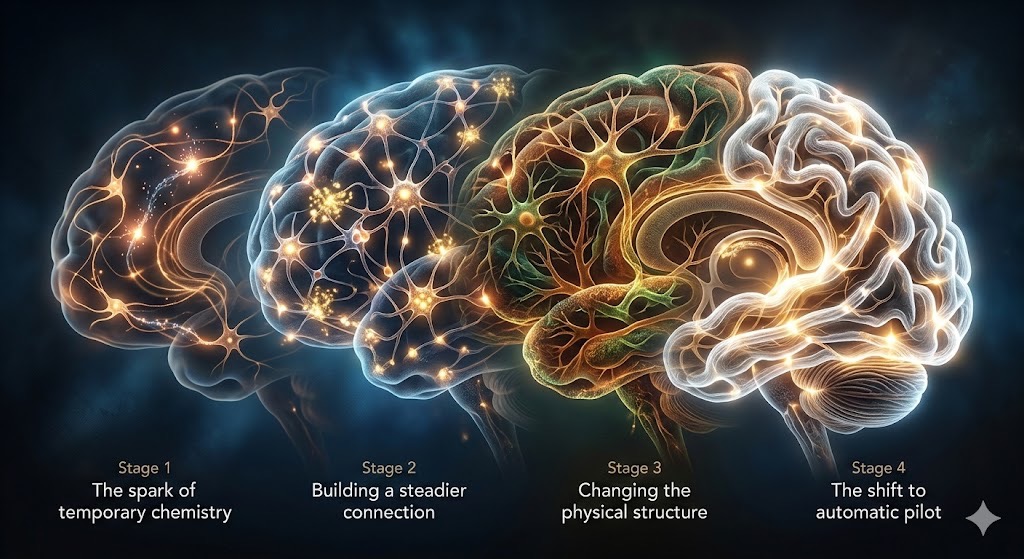 The final (fourth) stage is where the new behavior finally feels like who you are rather than something you are trying to do. Over the course of several months to a year, the brain wraps your most-used pathways in a fatty insulation called myelin. This insulation allows electrical signals to travel at lightning speed, making the communication between different parts of your brain incredibly coordinated and fast.
The behavior is now integrated into your brain’s default wiring. This is why you don’t have to think about how to tie your shoes or drive to work; those networks are heavily insulated and efficient. When you reach this stage, you aren’t fighting against your old self anymore because your brain has officially reorganized its map to favor the new path.
The next time you feel frustrated that a new habit feels hard, remember that you are likely just navigating the early chemical stages of a very real physical construction project. Your brain requires proof of necessity through repetition before it will commit to the heavy lifting of structural remodeling. Every time you repeat the action, you are essentially voting for a new neural architecture, and given enough votes, the brain has no choice but to rebuild itself in your favor.
Scotty


Leave a Reply