


Before you try to fix your child’s school problem, figure out what kind of problem it is …
A few years ago, a boy named Brooks came home from elementary school dejected, dropped his backpack on the floor and announced that his teacher hated him. He was sure he knew why. She had placed him in what he considered the worst reading group in his class. His mother’s first impulse was to confront the teacher, but she waited until she had a chance to talk with her privately. The explanation she heard was nothing like the one Brooks had brought home.
His teacher saw Brooks as friendly and something of a leader among the other children. She had placed him with reluctant readers because she hoped he could help draw them out. The classroom decision that looked to Brooks like evidence that his teacher disliked him had actually been influenced by qualities she appreciated in him. His mother could easily have marched into school prepared to solve a problem that did not exist. Brooks’s experience was later recounted in an article for parents published by Scholastic, the educational and children’s publishing company.
Something similar is going to happen in homes everywhere during the new school year. Children will come home with problems that sound as though they already contain their own explanations , such as “My teacher is mean,” “I can’t do math,” “Nobody talks to me,” or “I’m not going back.” A parent naturally wants to respond, particularly when a child is hurt or angry, but the first version of the story may not tell a parent what kind of help the child actually needs.
The challenge for parents is that a child’s description can make the appropriate response seem obvious when it may not be obvious at all. A complaint about a teacher can make a phone call to the school seem necessary, while a declaration of “I can’t do math” can sound like an academic problem that requires extra help. Yet until a parent understands what is actually behind the complaint, acting on that first impression can mean trying to solve the wrong problem.
Before trying to fix what happened at school, then, it helps to ask a different question: What kind of problem is this? Here are six possibilities worth considering.
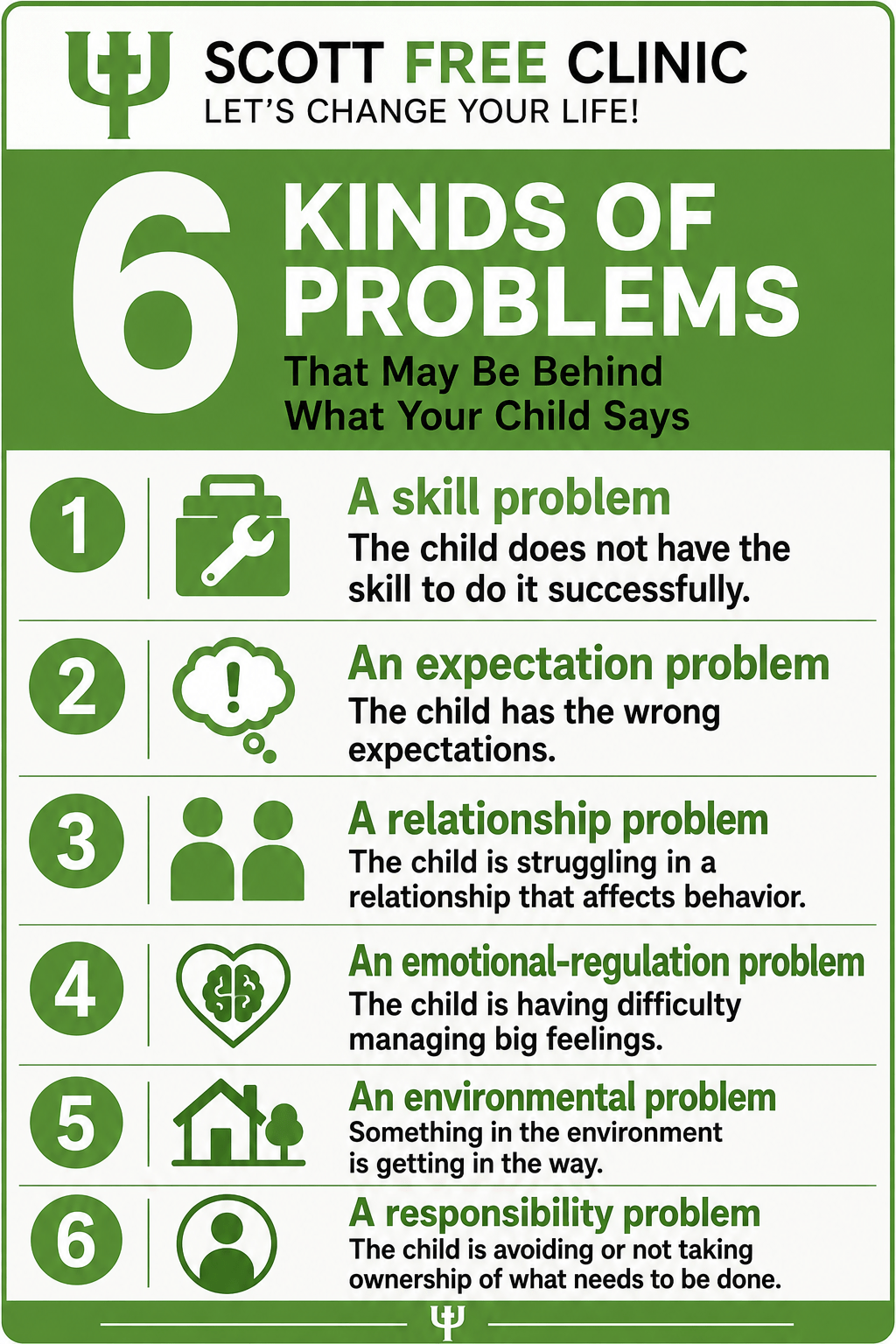 A skill problem
A skill problem exists when a child is expected to do something but has not yet developed the ability needed to do it successfully and consistently. Parents can easily mistake this for carelessness or irresponsibility because the child may understand what is supposed to happen. Knowing the goal, however, does not necessarily mean knowing how to accomplish it.
Maureen Paschal learned this while raising a daughter who repeatedly forgot books, misplaced papers, and struggled to keep track of assignments. Paschal initially attempted to have consequences teach responsibility, but after her daughter was diagnosed with ADHD, she realized that consequences were not teaching the organizational skills her daughter lacked. Writing for Understood, Paschal explained she began helping her daughter plan assignments and develop routines for managing schoolwork.
A parent who repeatedly says, “You have to be more organized,” may therefore be addressing the result rather than the difficulty causing it. If completed homework repeatedly stays on a bedroom desk, the child may need a dependable routine for getting finished work into the backpack and turned in the next day. If long-term projects repeatedly become last-minute emergencies, the missing skill may be breaking a large assignment into smaller tasks and scheduling them over time.
The practical question is “Does my child know how to do what is being expected?” If the answer is no, the appropriate response is teaching. Parents can identify where the process breaks down, teach a workable strategy, and gradually return responsibility to the child as the skill develops. Consequences cannot teach a skill that has never been learned.
An expectation problem
An expectation problem occurs when a child has a wrong or unrealistic expectation about what should happen at school, and that expectation causes the child to misinterpret or overreact to what actually happens. The child may expect schoolwork to remain easy, expect consistently high grades, expect a teacher to respond in a particular way, or expect friendships to develop quickly. The difficulty may be real, but a faulty expectation can make it appear much worse or mean something very different from what it actually means.
A child who has always earned excellent grades without much studying may eventually reach a class that requires substantial effort. If that child has come to expect being smart means school should be easy, normal academic struggle can feel like evidence of lost ability. The complaint “I can’t do this” may therefore require more than academic help. The child may need to understand that difficult work is supposed to require effort and that struggling to learn something does not demonstrate an inability to learn it.
Parents can often uncover this problem by asking, “What did you expect would happen?” A child devastated by a lower grade may have expected the same results without increasing the amount of study required. A child who feels rejected at a new school may have expected close friendships to develop within the first few weeks. Once the expectation becomes clear, parents can determine whether the situation itself needs to change or whether the child’s expectation needs to become more realistic.
The appropriate response is to help the child bring expectations into line with reality without lowering healthy standards. A capable student can still pursue excellent grades while understanding that harder courses may demand more work. A child can hope for close friendships while recognizing that meaningful relationships take time to develop. Realistic expectations allow disappointment to remain disappointment instead of becoming false evidence of failure or rejection.
A relationship problem
A relationship problem exists when the primary difficulty involves what is happening between the child and another person at school. The problem may involve a friend, a group of classmates, a teacher, or someone else the child regularly encounters. Because relationship difficulties can affect a child’s entire experience of school, they may eventually appear as declining grades, reluctance to attend school, or changes in behavior even though the original problem is interpersonal.
When a child says, “Nobody talks to me,” the parent knows the child feels isolated but does not yet know why. There may be deliberate exclusion or bullying, a friendship may have broken down, or the child may be struggling with the social skills needed to enter a group or resolve a disagreement. The child may also have contributed to a conflict without recognizing how his or her behavior affected the other person.
The practical question is “What is happening between my child and the other person?” Parents need enough information to understand the relationship before deciding whether to intervene. A friendship disagreement may call for helping the child decide how to approach the other person, while persistent mistreatment may require involvement from adults at school. If the child contributed to the problem, taking responsibility and repairing the relationship may be part of the solution.
Teacher difficulties should be approached in the same way. Brooks believed his teacher disliked him because he interpreted one classroom decision without knowing her reason for making it. Other children may have legitimate concerns about how a teacher is treating them. Listening carefully to the child and, when necessary, obtaining the teacher’s perspective helps parents determine whether the child needs guidance in handling the relationship or whether adult intervention is appropriate.
An emotional-regulation problem
An emotional-regulation problem occurs when a child’s frustration, anger, embarrassment, anxiety or other strong emotion becomes so difficult to manage that the emotional reaction begins interfering with the child’s ability to deal with the original school problem. The assignment, correction, or uncomfortable situation may have started the difficulty, but the child’s reaction has now become a significant part of it.
A child may begin homework frustrated by a difficult problem and eventually become so upset that thinking clearly about the assignment is nearly impossible. By the time the situation becomes a shouting match at home, the family may be dealing primarily with the behavior while overlooking the escalating frustration that preceded it. The behavior still requires appropriate limits, but preventing the same episode tomorrow requires helping the child recognize and manage the emotion earlier.
The useful question is “At what point does the emotion begin taking over?” Parents can help children notice the early signs that frustration or anxiety is increasing and develop ways to respond before they become overwhelmed. A child might learn to ask for help earlier, briefly step away from an assignment when frustration is escalating, or put an upsetting experience into words before reacting impulsively.
Persistent or unusually intense distress deserves additional attention. When emotional reactions regularly interfere with attending school, completing work, or functioning during the school day, parents may need information from the school or assistance from an appropriate professional to understand what is driving the reaction. The immediate goal is to help the child become increasingly able to experience strong emotions without allowing those emotions to control what happens next.
An environmental problem
An environmental problem exists when something about the conditions surrounding the child is contributing significantly to the school difficulty. Parents may naturally focus on the child’s motivation or behavior, but concentration, organization, and performance are also affected by where, when, and under what circumstances children are being asked to function.
A child who consistently struggles with demanding homework late in the evening may work much more effectively earlier, before fatigue has accumulated. A student who has difficulty concentrating in one class but functions well in every other class may be responding to something particular about that setting. The difference between the situations provides information that parents should not ignore.
The practical question is “What changes when this problem gets better or worse?” Looking for those differences can reveal conditions that are contributing to the difficulty. At home, parents may discover that timing, noise, interruptions, or access to distractions is making homework unnecessarily difficult. At school, a conversation with the child and teacher may reveal a classroom circumstance that can reasonably be addressed.
Changing an environmental problem does not mean arranging life so that children never have to tolerate inconvenience. It means removing unnecessary obstacles when doing so gives the child a reasonable opportunity to meet appropriate expectations. Sometimes changing the conditions allows parents to discover that the child was capable of succeeding all along.
A responsibility problem
A responsibility problem exists when the child understands what is expected, possesses the ability to do it, has a reasonable opportunity to do it, and nevertheless chooses not to. This possibility matters because parents can sometimes become so determined to understand a child’s difficulties that they inadvertently explain away choices for which the child should be accountable.
A teenager may complain that a teacher was unfair for giving a zero on an unfinished assignment. If the assignment was understood, adequate time was available, and nothing prevented the work from being completed, the central problem may be the teenager’s decision not to do it. Challenging the teacher over the consequence would then direct attention away from the choice that actually needs to be addressed.
The practical question is “Could my child reasonably have made a different choice?” Parents should answer that only after considering whether a missing skill, unrealistic expectation, relationship difficulty, overwhelming emotional response, or environmental obstacle better explains what happened. When those possibilities do not account for the problem, responsibility should remain with the child.
The appropriate response may include allowing a reasonable consequence to stand, requiring neglected work to be completed, or expecting the child to repair harm done to another person. Support does not require rescue. Children need opportunities to learn that their choices have consequences and that responsibility includes dealing honestly with those consequences.
When the answer is not just one problem
These six kinds of problems can overlap. A child who lacks an important academic skill may experience repeated failure, become anxious about the subject, and eventually develop conflict with the teacher. By the time the child says, “I hate school,” several problems may be operating at once. Parents do not need to force the situation into one category, but they do need to identify what is actually happening before deciding where to begin.
That may require information beyond the child’s first account. Parents can ask questions, watch for patterns and, when appropriate, talk with teachers who see the child in a setting parents do not. Significant academic, behavioral, or emotional difficulties may also require assistance from an appropriate professional. Unless there is an urgent concern, taking enough time to understand the problem is often more useful than immediately trying to make it disappear.
There is another benefit to approaching school problems this way. Children are watching how adults respond when something goes wrong. A parent who becomes curious before becoming corrective or protective demonstrates a valuable way of thinking: understand the problem first, then decide what the problem requires.
Eventually, children will need to do that without a parent standing beside them. They will encounter difficult work, disappointed expectations, troubled relationships, strong emotions, unfavorable circumstances, and consequences of their own choices throughout life. Helping them learn to recognize what kind of problem they are facing gives them something far more useful than a solution to whatever happened at school today.
Scotty


Leave a Reply