


A practical understanding of why sleep is so important …
Sleep is one of the most familiar parts of life and, at the same time, one of the least understood. Every night millions of people climb into bed expecting that hours of sleep will leave them rested and ready for another day. Sometimes it does, sometimes it doesn’t. Most people simply accept that difference without ever wondering what actually happened during those hours of sleep, or why one night can leave a person refreshed while another leaves them feeling as though they never slept at all.
Part of the answer is found in something many people have never heard of — the sleep cycle. Sleep is not one long, unchanging period of unconsciousness. From the time a person falls asleep until the time they wake, the brain repeatedly moves through a carefully organized sequence of stages. Each stage has its own purpose, each contributes something essential to health, and together they form a cycle that repeats several times during a healthy night’s sleep.
Understanding that simple truth changes the way sleep is viewed. Instead of thinking only about getting enough hours, it becomes possible to understand why the brain needs those hours arranged in a particular pattern. Those repeating cycles are not an accident of biology, they are the way the brain restores the body, strengthens the mind, processes experiences, and prepares them for another day.
The sleep cycle is made up of three distinct stages: light sleep, deep sleep, and rapid eye movement sleep, commonly known as REM sleep. Together, these three stages make up one complete sleep cycle, which typically lasts about 90 minutes. Rather than occurring randomly, these stages follow one another in a predictable order throughout the night. Once REM sleep is completed, the brain begins another cycle, repeating the same pattern several more times before morning arrives. Most healthy adults complete four to six of these cycles during a full night’s sleep, giving the brain repeated opportunities to perform the different kinds of work that each stage was designed to accomplish.
 The first stage is light sleep. Although its name may suggest very little is happening, light sleep is an active transition between wakefulness and deeper sleep. As this stage begins, the brain gradually reduces its awareness of the outside world. Heart rate slows, breathing becomes steadier, muscles begin to relax, and body temperature starts to fall as the body shifts away from the demands of the day. A person can still be awakened fairly easily during this stage, but the brain has already begun the process of moving into sleep.
Light sleep also prepares the brain for what comes next. It would be impossible for the brain to move instantly from full alertness into deep sleep. Instead, this stage provides a gradual transition that allows the nervous system to slow in an orderly way. During light sleep, the brain also produces brief bursts of electrical activity called sleep spindles. Researchers believe these bursts play an important role in strengthening newly learned information and helping stabilize memories, showing that even the earliest stage of sleep contributes to the brain’s work of restoration and learning.
Light sleep is also unique because it does not occur only once at the beginning of the night. The brain returns to this stage repeatedly as it moves from deep sleep into REM sleep and then begins another cycle. In other words, light sleep serves as the bridge that connects the other stages throughout the night. Far from being a brief introduction that is quickly left behind, it remains an essential part of every complete sleep cycle.
 As the brain completes its work in light sleep, it gradually moves into deep sleep. This is the stage many sleep specialists consider the most physically restorative part of the sleep cycle because it is during deep sleep that much of the body’s repair and recovery takes place. Brain waves become slower and more synchronized, the body becomes much more difficult to awaken, and the heart, lungs, and muscles are given an opportunity to recover from the demands of the day.
Deep sleep is when the body performs many of its most important housekeeping tasks. Growth hormone is released in greater amounts to support tissue repair and growth. The immune system becomes more active, helping strengthen the body’s defenses against illness. At the same time, scientists have learned that the brain’s waste-clearing system becomes especially active during deep sleep, removing metabolic byproducts that accumulate while a person is awake. This nightly cleaning process is now recognized as an important part of maintaining long-term brain health.
Deep sleep also contributes to learning and memory, although it does so differently than REM sleep. Throughout the day, the brain is flooded with new information. Deep sleep helps strengthen many of the memories and skills that are worth keeping, allowing important information to become more firmly established while unnecessary information gradually fades into the background. In many ways, deep sleep helps organize what was learned during the day before building upon it during the later stages of the night’s sleep.
One of the most interesting features of deep sleep is that it is not evenly distributed throughout the night. The first few sleep cycles contain the greatest amount of deep sleep, with each successive cycle containing a little less. That pattern helps explain why consistently staying up late or repeatedly interrupting the early part of the night can have a greater effect than many people realize. Even if enough total hours are eventually spent in bed, the brain may lose valuable time in the stage where much of its physical restoration normally occurs.
 As the brain completes its work in deep sleep, it moves into the third stage of the sleep cycle known as rapid eye movement sleep, or REM sleep. This stage receives its name from the rapid movements of the eyes beneath the closed eyelids. Although the body remains asleep, the brain becomes highly active. In fact, brain activity during REM sleep closely resembles the activity seen while a person is awake. At the same time, the body’s voluntary muscles become temporarily relaxed to the point that they are largely unable to move, a normal protective mechanism that helps prevent people from physically acting out their dreams.
REM sleep is the stage most closely associated with dreaming, and this is when the brain performs much of its emotional and cognitive work. Throughout the day, people accumulate experiences, conversations, challenges, successes, disappointments, and countless other thoughts and emotions. During REM sleep, the brain begins processing those experiences, helping organize memories, strengthen learning, connect new information with existing knowledge, and regulate emotional responses. Rather than simply storing the events of the day, the brain is actively deciding what should be retained, how it relates to what is already known, and how those experiences fit into a person’s understanding of life.
This role in emotional regulation is one reason REM sleep is so important. Many people have experienced going to bed overwhelmed by a problem only to find that it seems more manageable the next morning. The problem itself may not have changed, but the brain has continued working throughout the night. REM sleep appears to help reduce the emotional intensity attached to experiences while preserving the information they contain, allowing people to respond with greater clarity and perspective after a healthy night’s sleep.
Although REM sleep performs functions that no other stage can replace, it works in partnership with deep sleep rather than competing with it. Deep sleep provides much of the body’s physical restoration, while REM sleep contributes significantly to emotional health, memory, learning, and higher mental functioning. Both are essential, and together they demonstrate why the brain was designed to move through complete sleep cycles instead of remaining in a single stage throughout the night.
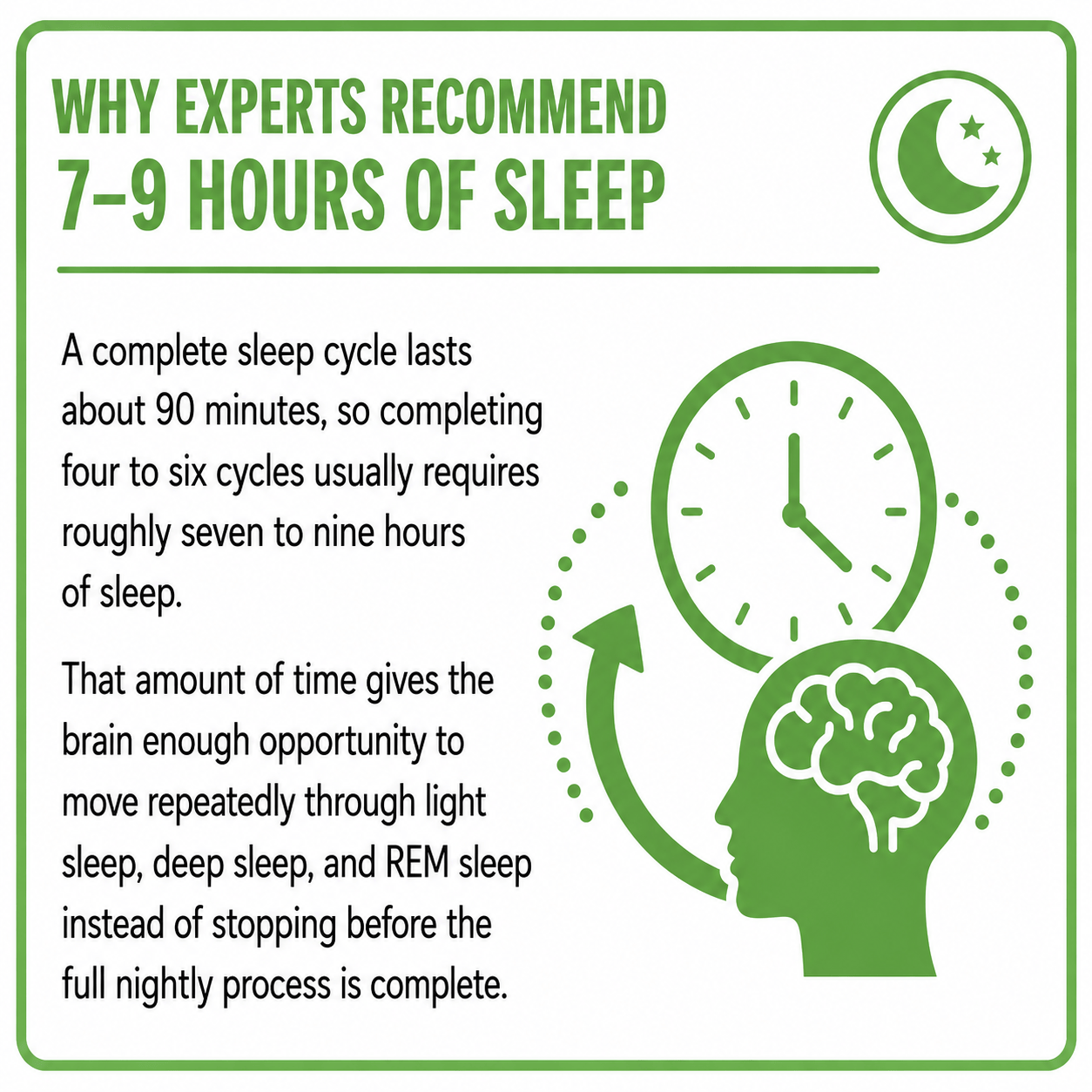 The importance of completing four to six sleep cycles becomes much easier to understand after seeing how each stage contributes something different. One cycle simply cannot accomplish everything the brain and body need. The first cycle provides an important beginning, but it is only that — a beginning. The brain was designed to repeat the entire sequence several times, with each cycle building on the work of the one before it.
A shortened or interrupted night of sleep affects more than simply the total number of hours spent in bed. Going to bed much later than usual may reduce the deep sleep that normally occurs during the earlier part of the night, while waking too early may shorten the longer REM periods that develop toward morning. Frequent awakenings can also prevent the brain from moving smoothly through its normal sequence of stages. Whether sleep is shortened or repeatedly interrupted, the result is the same—the brain loses opportunities to complete the restorative work that healthy sleep was designed to accomplish.
One of the greatest benefits of understanding the sleep cycle is that it changes the way bedtime is viewed. It is no longer simply the moment the day ends or the point at which exhaustion finally wins. Instead, it becomes the beginning of a carefully coordinated process that continues for hours without any conscious effort. While a person sleeps, the brain is actively carrying out responsibilities that cannot be postponed until tomorrow. Every completed cycle moves that work forward, preparing both the mind and body to meet the demands of a new day.
Modern life often encourages people to treat sleep as negotiable. Work, entertainment, busy schedules, late-night scrolling, and endless responsibilities can all seem more urgent than going to bed on time. Yet the brain does not view sleep as optional maintenance. It depends on those nightly cycles to perform work that supports clear thinking, emotional stability, learning, physical recovery, and overall health. When those cycles are repeatedly shortened or interrupted, the effects often appear gradually, making it easy to overlook the role that sleep has been playing all along.
Perhaps the simplest lesson from the sleep cycle is also one of the most valuable. Every morning is shaped, in part, by what happened the night before. The quality of tomorrow begins long before the alarm clock sounds. It begins when the brain is given the uninterrupted time it needs to complete the remarkable work it was designed to do while the rest of the body sleeps.
Scotty


Leave a Reply